Well, it happened.
A couple weeks back, I signed up for the lottery to get into the Garry Bjorklund half marathon. I'd tried once before, and didn't make it in, so I'm happy to make it in this time.
I grew up watching this and Grandma's Marathon every year, walking down the hill four blocks from my house to cheer on the runners at the top of the largest "hill" (Lemondrop) on the course. I always figured that if I ever ran a half or a full on roads, this would be the one to choose. I will pass my sister's house at exactly the halfway point, and pass my parents at Lemondrop, and see from there how I can finish.
It will be interesting to see what I can do on a road at sea level. My fastest half to date was run up near Boulder on the trails, so as long as I pace myself reasonably well I can pretty well bank on a PR.
It will be interesting. I hope it's fun as well.
Sunday, November 6, 2016

Monday, October 3, 2016
Back on the Wagon
The training plan wagon that is. As ever, I am already feeling more fit than I was before (even though I'm only on week three). There are a few things I'd forgotten about jumping on a training plan, though.
- The metabolic implication: I eat constantly again.
- Physically, I am more tired on a training plan than off of it. I sleep better, but am occasionally tired at odd times.
- Mentally, I find it easier to get out for a run if I have the raw numbers of a training plan staring me in the face.
- It's a whole lot easier going off of somebody else's training plan (I"m using Eric Orton's plan from "The Cool Impossible" again. It has worked for me in the past.), than trying to create my own. This one offers enough flexibility that I can easily alter it to my own needs.
- Training by heart rate works well for me.
I also found that my breathing methods (mentioned in my last post) match pretty well to my heart rate zones. If anything, I was running faster than I should have been when I was using rhythmic breathing alone.
Wednesday, August 24, 2016
A Focus on Breath
In my race report for the Eugene Curnow Trail Marathon, I went on a bit about my strategy of focusing on my breath for the race. I didn't go into much detail, but it definitely helped me out during the really difficult portions of the race (read, the last 15 miles).
Since the relative success of that race, despite the cramping, I have been continuing my experiments in rhythmic breathing, and I thought it worthwhile to write a post about it.
First, a general primer on rhythmic breathing, as I learned it. I believe I read about it first in an article on Competitor.com or a similar website. The basic theory is this: your core naturally contracts and activates on an inhalation, and relaxes and collapses on an exhalation. Most people run in an even pattern (2 steps in, 2 steps out, or a 3-3 or 4-4 pattern). This leads to the collapse always happening on the same foot, which can cause greater fatigue.
If, instead, you run on an odd pattern (3-2 or 4-3, or even 2-1 if you're running particularly quickly), you can even out the fatigue a little bit. It also provides a rough gauge of how hard you're working.
Additionally, the theory suggests that you should be breathing from your stomach and diaphragm rather than your lungs, as that gives you a fuller breath.
After a month or so of this, I have found quite a few advantages, and one disadvantage to this technique.
Advantages
Since the relative success of that race, despite the cramping, I have been continuing my experiments in rhythmic breathing, and I thought it worthwhile to write a post about it.
First, a general primer on rhythmic breathing, as I learned it. I believe I read about it first in an article on Competitor.com or a similar website. The basic theory is this: your core naturally contracts and activates on an inhalation, and relaxes and collapses on an exhalation. Most people run in an even pattern (2 steps in, 2 steps out, or a 3-3 or 4-4 pattern). This leads to the collapse always happening on the same foot, which can cause greater fatigue.
If, instead, you run on an odd pattern (3-2 or 4-3, or even 2-1 if you're running particularly quickly), you can even out the fatigue a little bit. It also provides a rough gauge of how hard you're working.
Additionally, the theory suggests that you should be breathing from your stomach and diaphragm rather than your lungs, as that gives you a fuller breath.
After a month or so of this, I have found quite a few advantages, and one disadvantage to this technique.
Advantages
- Fatigue: I have not gotten a single side stitch since trying, and sticking with this technique.
- Focus: as I said in my Eugene Curnow report, I found that this technique gave me a focus on when I was tired and cramping, and my mind was going dark places. I could focus on my breath and, despite my fatigue and cramping, I could still maintain a solid running pace.
- Meditation: On another note, I have found that I enter a more meditative state, since focusing on your breath is a central tenant of meditation, a practice I have recently taken up. I often end the run feeling much more mentally refreshed than I have in the past.
- Pacing: breath gives you an idea of where your pace is. 4/3 is generally very easy. 3/2 is getting into a harder, but sustainable pace. 2/1, well, that's hard.
Disadvantages
- I find it hard to actually get 4 steps on my inhale. And I sometimes have difficulty fully expelling on the exhale. It is something that's getting easer the more I practice, but it is a disadvantage.
- I know only 1 song with a 7/4 (or 7/8) beat. And I know 1 song with a 5/4 beat. This is an issue.
Has anybody else tried rhythmic breathing? I'd be curious to hear your thoughts and/or advice.
Wednesday, July 20, 2016
Eugene Curnow Race Report
That was one for the books.
Let's start with a little background. As you know, if you read this blog, I haven't been posting for a rather long time. That is because, between a move and a couple trips, I haven't been running all that much yet this summer. As a result, I came into this race underprepared, without a suitable long run, and having not trained seriously in a month or so. I had managed to get a couple solid runs in while I was on a trip to Colorado the week (!) before, and I think the move qualifies as good training (our entry is on the third floor).
Even so, I felt cautiously optimistic about my chances on the day. I thought that, if things went ok, I would run around 4 hours. If they went well, I could probably do 3:50 or 3:45. If they went poorly, I figured it would be around 4:15. Spoiler alert: I ran 4:11. Things went poorly.
The short version for those who want it: I started fast. I went for it from the start, taking advice from others who noted that the trail got more technical at parts as you went along. Despite some insole issues (I ended up taking them out entirely), I ran well through the first three aid stations. I averaged 8:30 pace or so through those sections, even with stops to take out my insoles, but then the wheels fell off. Right at mile 11, the cramps set in, and they didn't quit the rest of the race.
I considered dropping out. I didn't.
A more detailed description:
Pre Race:
I drove up from the Cities the night before. My dad was driving the same route as well, so we met up in Carlton, giving me the chance to leave my car there, and thereby get an extra hour of sleep. They had buses from the finish to the start leaving at 4:45AM. I wanted to avoid that.
It was somewhat surprising to me that my dad offered to get up early and drive me to the start. It should not have surprised me, as he has always jumped at the opportunity to watch any of the three siblings race or compete in any sporting event. His schedule for the day allowed him to come to the start and at least a couple aid stations, depending on how I was moving.
I can't think of a better motivation to move quickly than the chance to see your father at an extra aid station.
Start to Skyline: Cruising in the Early Morning Light
The low-key start was typical of trail races: a non-line in the dirt (seriously, there wasn't any indication of where the start line was), a few brief instructions, and "Go."
The likely race leaders sped off up the hill. I settled in with the following group. I had inklings already that the day might not go well. My legs didn't feel any spring from my taper. Nonetheless, I cruised this section easily, settling into the 3-2 breathing pattern (3 steps inhale, 2 steps exhale) that I would return to again and again over the course of the day.
Out of the dirt road and across the Spirit Mountain ski hill, the sun's rays still seemed almost parallel, and I reveled in the cool, clear morning. The forecast was for a pleasantly cool day for Minnesota in July, but I still wanted to take full advantage of the coolness of the early morning. On to Skyline Parkway, and I remarked to another runner how easy it seemed so far, to which a runner farther up the road said "Just wait, it's a little early to be saying that."
I cruised into the Skyline aid station at sub-6 minute pace, 3.5 miles into the race, 400+ up from the start, and 26 minutes into the race.
Skyline to Becks: Jarrow's Beach
Out of Skyline we took a turn uphill into the Magney-Snively nordic ski area. The trails here were deceptively smooth, but with the recent rains there were many low, swampy spots.
Partway through, still feeling good, I came up behind and older runner who had evidently started the race early. He was moving well, and I asked if he was the one runner who'd finished the race all 24 prior runnings. He was not, but was still inspiring.
I almost missed the turn for Jarrow's beach, but fortunately (I believe) Jarrow himself directed me down the hill and into the "beach." This was the first, and most, technical section of the course. It was an ugly mix of soccer ball-sized rocks, roots, water, and mud, and I picked my way more carefully than sometimes, not wanting to turn an ankle so early. I also took the opportunity to tighten my shoelaces.
Some more technical-minded runners passed me at this point. I don't often get passed, in Minnesota, on technical downhills, and I admit to being a little annoyed. But with new shoes (they were a week old) and uncertain training, I opted for discretion over valor. Soon enough, we came out onto the old railroad bed, where I again dropped the pace and passed the technical guys right back.
(One of the guys who passed me on Jarrow's beach mentioned that he would be running The Rut 50k in the fall, a race I hope to run myself some day)
This is where my left insole started causing me problems. My shoes were already soaked at this point, and the higher pace on the railroad grade caused my insole to bunch up in the front of my shoe. I've had this trouble with Altras before, but hadn't had ample time to test these shoes to see if they had the same issue.
At Becks, after seeing my dad for the second time in the race, and while getting my water bottle filled, I untied my shoe, adjusted my insole, and kept on running down the old dirt road, 7.5 miles and almost exactly 1 hour elapsed.
Becks to Fon-du-Lac: Speeding in frustration.
Not 100 yards from the aid station, my insole had already started bunching up again. In frustration, I knelt down to take off my shoe and remove it for good, to find my shoe was too tightly tied and I couldn't undo it. Fortunately, an angel of a spectator ran over and not only helped me take my shoe off, but took my insole to the lost and found for me.
Thank you!
Frustrated, I took off. I later found out on Strava that I had my third-fastest times (on Strava) for both the 1 mile and the 1 kilometer distance on this road(ish) stretch. I again passed those who had passed me at the aid station before we dropped off the road and into the woods to what was probably my favorite part of the trail.
Off the road, we stepped into a pine forest and a soft, gentle single track weaving along a ridge. I admit, these are my favorite trails: smooth, gliding, and gentle on your feet (especially when one foot is sans insole). There were parts along the ridge that were rather exposed, making me slow down lest I stumble to one side or the other and tumble down the hill. Then, at the end, it dumps you down the only section of ropes on the course. I admit to almost running straight into a log that sat at about chest height right at the bottom of the ropes.
My right insole started bunching up in this section, and I decided that at the next aid station, it would go. 10.7 miles in, 1:27 elapsed, remaining insoles: 0.
Fon-du-Lac to Seven Bridges: Cursing my Calves.
Much to my surprise, my dad was waiting again at this aid station. I figured he'd be gone by that point, but as he said I was "moving well."
And I was. I was feeling great about how the race was going so far. I was pushing, but it felt sustainable I was sticking to my 3-2 rhythmic breathing. I'd covered almost 11 miles in under an hour and a half. I was moving well, despite my insole issues.
Out of the aid station, and on the first climb, the wheels started to come off: I felt the beginnings of cramps in my calves. I tried to get on top of them: I immediately popped (and bit, and coughed on) an electrolyte tab, and upped my consumption of these from every 45 minutes to every half hour. In the past, that was enough to stave off cramps. Today not so much. I upped my intake of gels and tabs to every half hour, and hoped that would be enough.
Even with the cramping, I managed to hold my own through here and not get passed. But I knew the rest of the morning would be difficult. 12.7 miles in, 1:46 elapsed, properly functioning calves: 0.
Seven Bridges to Grand Portage: The Power Lines
I'd heard, of course, of the infamous power lines. I knew of the 9 brutal hills, the lack of shade, and the brambles. I found them to be both better and worse than I expected.
Not for the first time, nor the last, I was glad I was in the first 20-30 runners. With the wet weather, the power lines were muddy, the creeks were high, and the footing was difficult. I can only imagine that it got much, much worse as the day went on and more people scrambled these hills. Gradients of up to 40% don't make for swift going on the best days.
Even so, I found these less difficult than I anticipated. The steep uphills let do some dynamic stretching on my calves, and the steep downhills were reckless and fun. The descents were steep, short, and muddy enough that I knew I could slide if I got out of control. Save for grabbing a raspberry bush at one point (ow) this section went better than I had feared.
Two hills of purgatory (not nearly as bad as they suggest) and into Grand Portage. 15.5 miles in, 2:17 elapsed, 3 steps in, 2 steps out.
Grand Portage to Petersen's: Quads are Gone
This section just got hard. My quads started cramping up at this point. People started passing me. I could run for a little while, at a slowish pace, but then my quads would seize up and I would be forced to walk for a while as I tried to loosen them up.
Even so, the trails were beautiful double track. If I am calculating correctly, it was about 8:30 in the morning: a little before the time I usually start running in the morning. Despite the condition of my legs and the difficulties I was having, I was still grateful to be out, even as I was debating dropping.
It's not a true race unless you consider dropping out, right?
17.5 miles in, 2:39 on the clock, functioning quads:0.
Petersen's to Forbay: Still Cramping.
I'll be honest, it's Wednesday now while I'm writing this section (I started on Monday) and I don't recall this section all that well. It was difficult again, but I managed to keep going and push through.
And I began to notice something interesting in this section: there were still times where I just didn't feel like I could move. My quads and calves were still cramping horribly. Even so, I found that if I could just focus on three steps in, two steps out, I could actually move at a decent pace. In fact, it was almost as quick a pace as I maintained during the first part of the race. I also found that, as is the case with meditation, focusing on my breath is an excellent way to pull my focus away from anything else.
I could still feel the discomfort and seizing, it just didn't matter as much.
Out onto the Munger trail, and I knew I should really be pushing it again. I managed a solid 7:30-7:45 pace. Even so, I was passed on this section.
"How's it going?"
"Cramping"
"Oh, that's a tough way to run."
"Well, I've been running on it for 10 miles, so I'm used to it."
"Ha. Good luck!"
20.5 miles in, 3:09 Elapsed. No 4 hour marathon likely.
Forbay to Jay Cooke: Flat Trails.
Not much to say on this section. I knew I could finish at this point. All thoughts of dropping out were behind me. Now it was just a matter of keeping on. I hit a very decent pace on the dam, after devouring a pickle at the aid station. The cramps soon caught up again, and I stepped to the side of the double track cross country ski trail (to relieve myself) as another person passed.
At this point, I was out of all competition except the one with my self. Or so I thought.
During one particularly agonizing stretch of cramp-induced walking, a runner I had been swapping back and forth with the entire race passed me again.
"You're gonna pass me one more time, aren't you?"
I wasn't so sure, but he turned out to be prophetic.
22.9 miles in. 3:34 elapsed. Pickles consumed: 1.
Jay Cooke to Finish: Enter the Gnar.
Another aid station meant another pickle.
Across the Swinging Bridge! I'd been waiting for this the entire race, and now I found myself a little seasick, to be honest.
A brief bit of smooth, easy trail quickly gave way to remarkably gnarly single track along the St. Louis River. I slowed to a walk often in these last three miles, now counting down the tenths of a mile rather than focusing as much on my breath. When I did, though, I still managed to run at a normal pace, which is still remarkable to me.
I was passed by a couple runners in this section, though fewer than I expected. And I did, indeed, pass my trail buddy for a last time shortly before popping out to the Munger Trail again for the finishing "sprint."
26.2 miles completed, 4:11 elapsed. Marathons completed (total, not including ultras): 4.
Let's start with a little background. As you know, if you read this blog, I haven't been posting for a rather long time. That is because, between a move and a couple trips, I haven't been running all that much yet this summer. As a result, I came into this race underprepared, without a suitable long run, and having not trained seriously in a month or so. I had managed to get a couple solid runs in while I was on a trip to Colorado the week (!) before, and I think the move qualifies as good training (our entry is on the third floor).
Even so, I felt cautiously optimistic about my chances on the day. I thought that, if things went ok, I would run around 4 hours. If they went well, I could probably do 3:50 or 3:45. If they went poorly, I figured it would be around 4:15. Spoiler alert: I ran 4:11. Things went poorly.
The short version for those who want it: I started fast. I went for it from the start, taking advice from others who noted that the trail got more technical at parts as you went along. Despite some insole issues (I ended up taking them out entirely), I ran well through the first three aid stations. I averaged 8:30 pace or so through those sections, even with stops to take out my insoles, but then the wheels fell off. Right at mile 11, the cramps set in, and they didn't quit the rest of the race.
I considered dropping out. I didn't.
A more detailed description:
Pre Race:
I drove up from the Cities the night before. My dad was driving the same route as well, so we met up in Carlton, giving me the chance to leave my car there, and thereby get an extra hour of sleep. They had buses from the finish to the start leaving at 4:45AM. I wanted to avoid that.
It was somewhat surprising to me that my dad offered to get up early and drive me to the start. It should not have surprised me, as he has always jumped at the opportunity to watch any of the three siblings race or compete in any sporting event. His schedule for the day allowed him to come to the start and at least a couple aid stations, depending on how I was moving.
I can't think of a better motivation to move quickly than the chance to see your father at an extra aid station.
Start to Skyline: Cruising in the Early Morning Light
The low-key start was typical of trail races: a non-line in the dirt (seriously, there wasn't any indication of where the start line was), a few brief instructions, and "Go."
The likely race leaders sped off up the hill. I settled in with the following group. I had inklings already that the day might not go well. My legs didn't feel any spring from my taper. Nonetheless, I cruised this section easily, settling into the 3-2 breathing pattern (3 steps inhale, 2 steps exhale) that I would return to again and again over the course of the day.
Out of the dirt road and across the Spirit Mountain ski hill, the sun's rays still seemed almost parallel, and I reveled in the cool, clear morning. The forecast was for a pleasantly cool day for Minnesota in July, but I still wanted to take full advantage of the coolness of the early morning. On to Skyline Parkway, and I remarked to another runner how easy it seemed so far, to which a runner farther up the road said "Just wait, it's a little early to be saying that."
I cruised into the Skyline aid station at sub-6 minute pace, 3.5 miles into the race, 400+ up from the start, and 26 minutes into the race.
Skyline to Becks: Jarrow's Beach
Out of Skyline we took a turn uphill into the Magney-Snively nordic ski area. The trails here were deceptively smooth, but with the recent rains there were many low, swampy spots.
Partway through, still feeling good, I came up behind and older runner who had evidently started the race early. He was moving well, and I asked if he was the one runner who'd finished the race all 24 prior runnings. He was not, but was still inspiring.
I almost missed the turn for Jarrow's beach, but fortunately (I believe) Jarrow himself directed me down the hill and into the "beach." This was the first, and most, technical section of the course. It was an ugly mix of soccer ball-sized rocks, roots, water, and mud, and I picked my way more carefully than sometimes, not wanting to turn an ankle so early. I also took the opportunity to tighten my shoelaces.
Some more technical-minded runners passed me at this point. I don't often get passed, in Minnesota, on technical downhills, and I admit to being a little annoyed. But with new shoes (they were a week old) and uncertain training, I opted for discretion over valor. Soon enough, we came out onto the old railroad bed, where I again dropped the pace and passed the technical guys right back.
(One of the guys who passed me on Jarrow's beach mentioned that he would be running The Rut 50k in the fall, a race I hope to run myself some day)
This is where my left insole started causing me problems. My shoes were already soaked at this point, and the higher pace on the railroad grade caused my insole to bunch up in the front of my shoe. I've had this trouble with Altras before, but hadn't had ample time to test these shoes to see if they had the same issue.
At Becks, after seeing my dad for the second time in the race, and while getting my water bottle filled, I untied my shoe, adjusted my insole, and kept on running down the old dirt road, 7.5 miles and almost exactly 1 hour elapsed.
Becks to Fon-du-Lac: Speeding in frustration.
Not 100 yards from the aid station, my insole had already started bunching up again. In frustration, I knelt down to take off my shoe and remove it for good, to find my shoe was too tightly tied and I couldn't undo it. Fortunately, an angel of a spectator ran over and not only helped me take my shoe off, but took my insole to the lost and found for me.
Thank you!
Frustrated, I took off. I later found out on Strava that I had my third-fastest times (on Strava) for both the 1 mile and the 1 kilometer distance on this road(ish) stretch. I again passed those who had passed me at the aid station before we dropped off the road and into the woods to what was probably my favorite part of the trail.
Off the road, we stepped into a pine forest and a soft, gentle single track weaving along a ridge. I admit, these are my favorite trails: smooth, gliding, and gentle on your feet (especially when one foot is sans insole). There were parts along the ridge that were rather exposed, making me slow down lest I stumble to one side or the other and tumble down the hill. Then, at the end, it dumps you down the only section of ropes on the course. I admit to almost running straight into a log that sat at about chest height right at the bottom of the ropes.
My right insole started bunching up in this section, and I decided that at the next aid station, it would go. 10.7 miles in, 1:27 elapsed, remaining insoles: 0.
Fon-du-Lac to Seven Bridges: Cursing my Calves.
Much to my surprise, my dad was waiting again at this aid station. I figured he'd be gone by that point, but as he said I was "moving well."
And I was. I was feeling great about how the race was going so far. I was pushing, but it felt sustainable I was sticking to my 3-2 rhythmic breathing. I'd covered almost 11 miles in under an hour and a half. I was moving well, despite my insole issues.
Out of the aid station, and on the first climb, the wheels started to come off: I felt the beginnings of cramps in my calves. I tried to get on top of them: I immediately popped (and bit, and coughed on) an electrolyte tab, and upped my consumption of these from every 45 minutes to every half hour. In the past, that was enough to stave off cramps. Today not so much. I upped my intake of gels and tabs to every half hour, and hoped that would be enough.
Even with the cramping, I managed to hold my own through here and not get passed. But I knew the rest of the morning would be difficult. 12.7 miles in, 1:46 elapsed, properly functioning calves: 0.
Seven Bridges to Grand Portage: The Power Lines
I'd heard, of course, of the infamous power lines. I knew of the 9 brutal hills, the lack of shade, and the brambles. I found them to be both better and worse than I expected.
Not for the first time, nor the last, I was glad I was in the first 20-30 runners. With the wet weather, the power lines were muddy, the creeks were high, and the footing was difficult. I can only imagine that it got much, much worse as the day went on and more people scrambled these hills. Gradients of up to 40% don't make for swift going on the best days.
Even so, I found these less difficult than I anticipated. The steep uphills let do some dynamic stretching on my calves, and the steep downhills were reckless and fun. The descents were steep, short, and muddy enough that I knew I could slide if I got out of control. Save for grabbing a raspberry bush at one point (ow) this section went better than I had feared.
Two hills of purgatory (not nearly as bad as they suggest) and into Grand Portage. 15.5 miles in, 2:17 elapsed, 3 steps in, 2 steps out.
Grand Portage to Petersen's: Quads are Gone
This section just got hard. My quads started cramping up at this point. People started passing me. I could run for a little while, at a slowish pace, but then my quads would seize up and I would be forced to walk for a while as I tried to loosen them up.
Even so, the trails were beautiful double track. If I am calculating correctly, it was about 8:30 in the morning: a little before the time I usually start running in the morning. Despite the condition of my legs and the difficulties I was having, I was still grateful to be out, even as I was debating dropping.
It's not a true race unless you consider dropping out, right?
17.5 miles in, 2:39 on the clock, functioning quads:0.
Petersen's to Forbay: Still Cramping.
I'll be honest, it's Wednesday now while I'm writing this section (I started on Monday) and I don't recall this section all that well. It was difficult again, but I managed to keep going and push through.
And I began to notice something interesting in this section: there were still times where I just didn't feel like I could move. My quads and calves were still cramping horribly. Even so, I found that if I could just focus on three steps in, two steps out, I could actually move at a decent pace. In fact, it was almost as quick a pace as I maintained during the first part of the race. I also found that, as is the case with meditation, focusing on my breath is an excellent way to pull my focus away from anything else.
I could still feel the discomfort and seizing, it just didn't matter as much.
Out onto the Munger trail, and I knew I should really be pushing it again. I managed a solid 7:30-7:45 pace. Even so, I was passed on this section.
"How's it going?"
"Cramping"
"Oh, that's a tough way to run."
"Well, I've been running on it for 10 miles, so I'm used to it."
"Ha. Good luck!"
20.5 miles in, 3:09 Elapsed. No 4 hour marathon likely.
Forbay to Jay Cooke: Flat Trails.
Not much to say on this section. I knew I could finish at this point. All thoughts of dropping out were behind me. Now it was just a matter of keeping on. I hit a very decent pace on the dam, after devouring a pickle at the aid station. The cramps soon caught up again, and I stepped to the side of the double track cross country ski trail (to relieve myself) as another person passed.
At this point, I was out of all competition except the one with my self. Or so I thought.
During one particularly agonizing stretch of cramp-induced walking, a runner I had been swapping back and forth with the entire race passed me again.
"You're gonna pass me one more time, aren't you?"
I wasn't so sure, but he turned out to be prophetic.
22.9 miles in. 3:34 elapsed. Pickles consumed: 1.
Jay Cooke to Finish: Enter the Gnar.
Another aid station meant another pickle.
Across the Swinging Bridge! I'd been waiting for this the entire race, and now I found myself a little seasick, to be honest.
A brief bit of smooth, easy trail quickly gave way to remarkably gnarly single track along the St. Louis River. I slowed to a walk often in these last three miles, now counting down the tenths of a mile rather than focusing as much on my breath. When I did, though, I still managed to run at a normal pace, which is still remarkable to me.
I was passed by a couple runners in this section, though fewer than I expected. And I did, indeed, pass my trail buddy for a last time shortly before popping out to the Munger Trail again for the finishing "sprint."
26.2 miles completed, 4:11 elapsed. Marathons completed (total, not including ultras): 4.
Monday, June 6, 2016
Parkour and Trail Running: A Training Update
It's been a while. My posting always comes in waves.
I am coming off two very solid weeks of training for me, of 40 and 45 miles, respectively. I added in four honest workouts in those two weeks as well, along with two solid long runs. I can already tell that this week is likely to be much less intensive. I'm off to Duluth tomorrow, and I went for an hour-long bike ride (with a bit of a misadventure in the middle) instead of running today.
At the same time, I have, with my fiancee, been getting more into Parkour again. Lately this involves going to the local Parkour gym, which we are fortunate to have, three times a week. This gives us two classes per week, and one open gym session on Saturdays. We have been adding a short (15-minute) strength workout before or after each gym session as well, which in the short week and a half we have been doing it has already made a huge difference in our overall Parkour ability.
Better still, I've done two long runs in the last two weeks, each a bit over 15 miles. I ran at Afton a week ago, and ran from home this past weekend to cut down on the overall time my long run took. After all, I had to get to the Parkour gym by 1PM.
All in all, training has been going well. So well, in fact, that I have had less time to pause and take pictures, but I will post the few I've taken in any case.
I am coming off two very solid weeks of training for me, of 40 and 45 miles, respectively. I added in four honest workouts in those two weeks as well, along with two solid long runs. I can already tell that this week is likely to be much less intensive. I'm off to Duluth tomorrow, and I went for an hour-long bike ride (with a bit of a misadventure in the middle) instead of running today.
At the same time, I have, with my fiancee, been getting more into Parkour again. Lately this involves going to the local Parkour gym, which we are fortunate to have, three times a week. This gives us two classes per week, and one open gym session on Saturdays. We have been adding a short (15-minute) strength workout before or after each gym session as well, which in the short week and a half we have been doing it has already made a huge difference in our overall Parkour ability.
Better still, I've done two long runs in the last two weeks, each a bit over 15 miles. I ran at Afton a week ago, and ran from home this past weekend to cut down on the overall time my long run took. After all, I had to get to the Parkour gym by 1PM.
All in all, training has been going well. So well, in fact, that I have had less time to pause and take pictures, but I will post the few I've taken in any case.
 |
| A humid day at Minnehaha |
 |
| Happy Place |
 |
| Oh yeah, I took a trip up to Duluth in there too. |
 |
| Good morning, hometown. |
Tuesday, May 17, 2016
The Importance of Slowing Down
I like going fast.
I'm a runner: it goes with the territory.
But this past week, I was forced to slow down for two reasons. The first is that I was increasing my mileage rather drastically over my average for the past few weeks (about 25% or so). That necessitated me slowing down, particularly on my long run Saturday. The second happened today. I took my car in for service. When I do that, I walk back and forth (forth and back?) to the service station, about a mile and a half total, over streets I run on a daily basis.
There are a number of indications that slowing down has beneficial effects for runners. Running about 80% easy and 20% fast seems to be a solid ratio. Matt Fitzgerald has a book on the subject: 80/20 Running. I don't feel any need to go into that here.
For me, slowing down on Saturday meant I felt more open to slowing my pace, and even stopping, so that I could take pictures. The slower pace also meant that I noticed more minute details to take pictures of. All of a sudden, I noticed deer prints all over the forest floor.
I paused to take a picture of the trail's end.


I'm a runner: it goes with the territory.
But this past week, I was forced to slow down for two reasons. The first is that I was increasing my mileage rather drastically over my average for the past few weeks (about 25% or so). That necessitated me slowing down, particularly on my long run Saturday. The second happened today. I took my car in for service. When I do that, I walk back and forth (forth and back?) to the service station, about a mile and a half total, over streets I run on a daily basis.
There are a number of indications that slowing down has beneficial effects for runners. Running about 80% easy and 20% fast seems to be a solid ratio. Matt Fitzgerald has a book on the subject: 80/20 Running. I don't feel any need to go into that here.
For me, slowing down on Saturday meant I felt more open to slowing my pace, and even stopping, so that I could take pictures. The slower pace also meant that I noticed more minute details to take pictures of. All of a sudden, I noticed deer prints all over the forest floor.
I paused to take a picture of the trail's end.

I spotted growths of some sort of mushroom, I think they may be oyster mushrooms or a similar variety.


There had been a number of controlled burns in the area of Battle Creek Park, mostly burning downed trees. They were clearly recent, and had not been there the last time I ran in the area, but small flowers were already blooming in the burn scars.

Later on, in Battle Creek Park proper, I saw a large number of columbines leaning over the path.
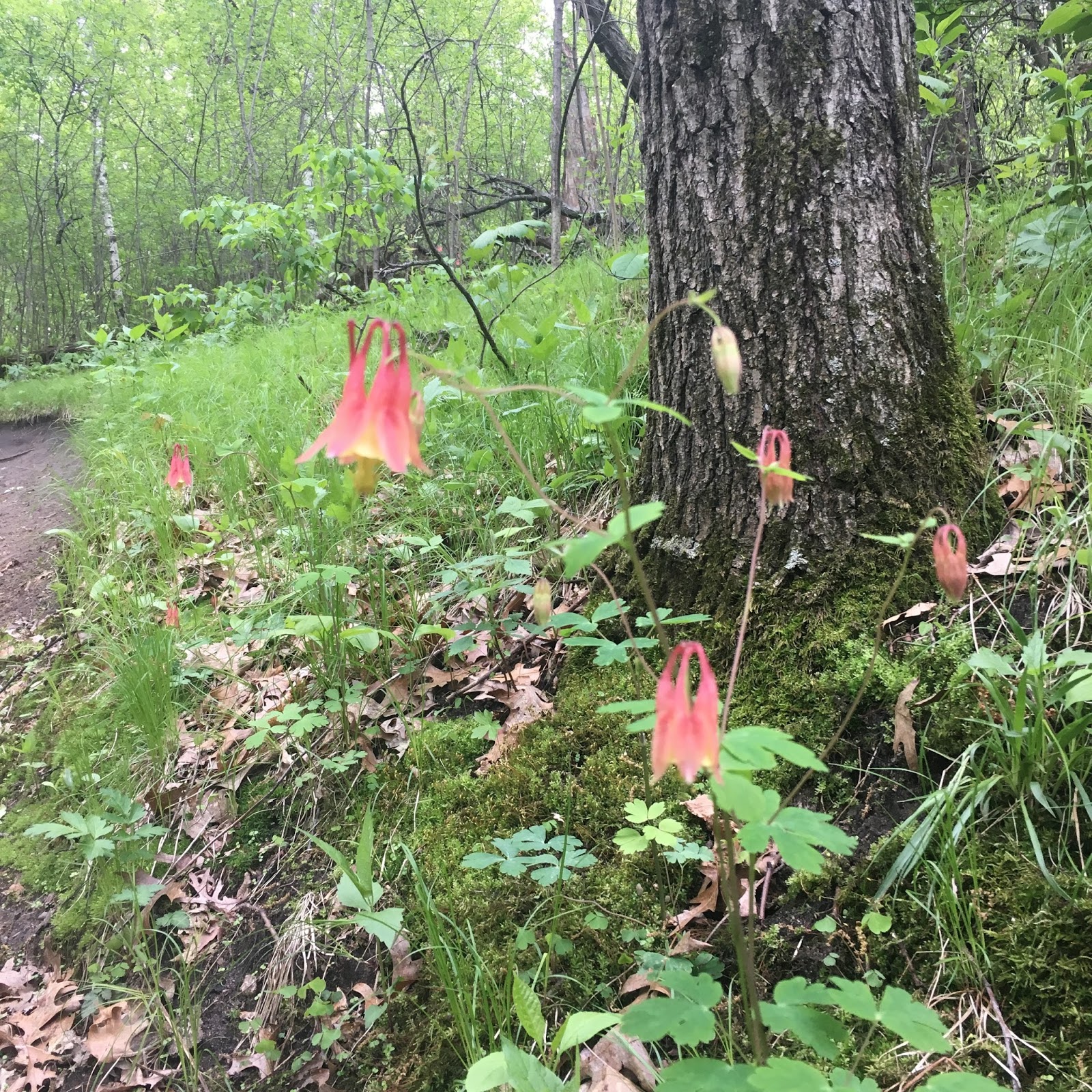
As the run went on, my legs actually felt better. I ran more, and took fewer pictures. But I am glad I started off slowly.
Today, walking along sidewalks I normally run. This was somewhat of a re-revelation to me. I realized again what a beautiful neighborhood I live in. I stopped and listened to the birds. I stopped and looked at the churches. I gloried in the bluebird skies and cool morning temperatures.
I and I moved slowly home.
Monday, May 9, 2016
GoSpring Trail 10k
 |
| Looks like I'm excited. I'm really more apprehensive. Photo credit Jamison Swift. |
Once again, I was standing at the start line of a race, with my legs still somewhat shot from the week before. Once again, this was the idea.
This time, though, I was on familiar ground. While I wouldn't say I know the Battle Creek trails like the back of my hand yet, I run them fairly often, and know their character if nothing else. The primary aspects of that character are 1) double track XC ski trails and 2) lots of short, steep uphills and downhills.
As always, I had a few goals for this race. I always want to negative split, and it rarely happens, particularly in trail races. This time, I had an A goal of running splits of around 7 minutes or a bit under. My B goal was to finish in under 45 minutes (not generally a tall order for 10k for me, but this course creeps up on you). And, as always, my C goal was to finish. As it turns out, I did all three, finishing in just under 43 minutes, at 6:54 pace.
My warmup jogs let me know that my legs were not exactly fresh. I'd done a typical amount of running the week leading up to this one, including hills and surges with a fair number of miles thrown in. I had also done a strength workout on Thursday. Not the best way to prep for a race, but I was hoping it was a good way to get the most training benefit out of it.
As is typical in Minnesota races (or so I've noticed) nobody wanted to start out at the front, but as the countdown started, a pack moved up and I got swept up in the lead group. I stuck with them for, oh, 400 meters before realizing that probably wasn't a good idea and I let them go. I let the chase pack catch me up, and proceeded to chat my way up the first (and as it turns out biggest) hill of the 5k loop.
On the second mile, I swapped the lead in the chase group with a couple other runners, usually losing ground on the uphill and gaining it back as I recklessly through myself into the downhills and coasted the flats (I've gotten to the point where I can call 6:30s "coasting!"). But as we entered the third mile and the biggest downhill of the course, I left them behind for the last time.
I made a mistake here: I had anticipated that the course would be the same as the course for the 5 and 10k races that take place in October. In those, there had been a huge, steep hill around mile 3. They changed the course this time, leaving that hill out. Had I known, I might have gone harder on the uphills. But given the later stages of this race, I think it's a good thing I assumed the hill was still coming.
 |
| Cruising down a nicely woodchipped hill. Photo credit Jamison Swift |
I rolled through the lap at a tiny bit over 21 minutes, right where I was ideally hoping to be. The 5k runners gave a solid cheer as I passed by the start line (thanks!), and even better, I could see the runner in front of me. He must have dropped the pace a lot to come back to me, so I thought I could focus on reeling him in for the remainder of the race.
My pace lagged a bit in the second mile of the second lap, but the guy in front of me was still visible for the most part. I was, however, beginning to feel the race in my legs. Keeping the tempo up started to be a struggle, and I occasionally glanced over my shoulder to see if anybody was catching up.
Nobody was.
Entering the final mile, I was hurting, breathing hard. But I still thought I could catch the runner in front of me. I focused again on reeling him in, letting that pull me through the last section.
I think, though, that I must have been breathing loudly by this point, because he resisted all my efforts to close the remaining 8 second difference. I came in at 42:50 for 7th place over all, and 3rd in my age group.
All in all, another solid, early season race for me. I think these short (ish) races are helping my mental toughness. In my opinion, the 10k is one of the most difficult race distances from a mental standpoint. It's got nearly the speed of a 5k, but double the distance. All in all, a great test.
Subscribe to:
Posts (Atom)