Saturday, October 9, 2021

Superior 50 Long Form Race Report

 Four weeks ago today, I successfully completed my first 50(+) mile race at the 2021 fall Superior trail races. I had tried the distance twice before, in a race and on my own, but both times pulled out after 34 miles (about the longest I’ve ever run). This time, my goals were different: I just wanted to finish, and feel good doing so. I succeeded beyond anything I expected. 


As I write this introduction four weeks after the race, my legs are still a little flat, but I am, perhaps inevitably, already plotting my next few long efforts. 


Background:


This race was a long time coming. The 2020 Superior 50 miler, had it happened, would have been my first goal race since 2018. I ran a few short races in 2019, but nothing that I would call a “focus” race. Then, of course, the 2020 race did not happen due to the pandemic. In all honesty, that cancellation was probably the best thing that could have happened to me: it allowed me another full year of focused, uninterrupted training. 


That the race happened at all was not a given: just when John, the race director, was relatively assured that the race would happen despite the pandemic, a large wildfire sparked near the start line of the 50 mile race. For several weeks leading up to the race on September 11, all the campsites on the Superior Hiking Trail were closed. The air quality bounced from ok to “Unhealthy for Everybody,” sometimes several times a day. The forest-service appropriated the start line area of the 50 mile race as their headquarters and campground. It looked like, despite John’s efforts, the race would be cancelled a second year in a row. 


I had all but given up on the race happening at all when, with the help of some well-timed rain, the firefighter succeeded in building containment lines around the fire. John worked tirelessly to make sure the race could happen in a safe way, and only cleared us to run when the agencies involved were not only ok with the race happening, but encouraged him to put it on. So a huge thank you goes out to John and his wife Cheri for always putting so much of themselves into these races. 


The Lead Up:


The lead up to this race, at least for me, was a little difficult. September is always a busy time at work for me, and this week was no exception. Work did not want to let me go on Friday afternoon, and my wife and I ended up leaving the Twin Cities about half an hour later than I would have liked. Fortunately the drive to Duluth went smoothly, and we were able to stop for a sit-down dinner at the Corktown Deli before dropping my wife with my parents (this let her skip my 2:30 AM wakeup call the next morning: a good decision for both of us). 


The drive from Duluth to Lutsen also went smoothly, and I rolled into Caribou Highlands for check-in at 7:30, a full half-hour before it closed. Checked in and with my drop bags deposited, it was on to Cascade River State Park to set up my tent (I was lucky enough to snag a campsite less than two weeks in advance, unheard of for the north shore in the fall), have a second dinner, and settle in for whatever sleep I could get before the 2:30 alarm. 


(Interlude)


I wake up to distant “woos” and the sound of “Ice Ice Baby” blaring through the trees. There’s a wedding reception going on at the lodge near the Cascade River. Unfortunate, but at the same time I find it somewhat hilarious. 


I check my phone: 12:00AM. Confused, I check my watch: 11:00PM. My phone thinks it’s in Canada. The reception turns out to be a blessing in disguise. 


Eventually, after “It’s a Great Day to Be Alive” and “Funky Comatina,” I drift to sleep to the dulcet sounds of “Hammertime.” 


Race Morning


2:30, of course, came far too early. I had managed maybe four hours of restless sleep, at most. Even so, I get up, start my coffee, make my breakfast (a peanut butter and avocado sandwich), and strikecamp in what feels like record time, glad that the forecast rain never materialized. Then it was back to Caribou Highlands at Lutsen to pick up the shuttle to the race start. The shuttle ride, all 45 minutes of it, passed in relative quiet, a remarkable occurrence for a bunch of trail runners about to embark on an ultra: normally you can’t shut us up. 


The start line was a lower-key affair than usual. Since the Forest Service was using the normal start area as a headquarters, we gathered in a nearby parking lot for the race start. The upside of being in a parking lot instead of a building: the stars. Living in the Cities, sometimes I forget just how stunning the stars can be out away from the lights. 


During the pre-race briefing, I found my friend Tim O - Tim is 6’5” and easy to spot - and another, familiar looking tall runner and joined them in cheering (quietly) for the start of the race. With Tim’s quick quip of “this is the start line for the 5k, right?” we were off. 


Section one: Finland to Sonju Road - An Acquaintance and a Few Lost Souls


The race started up a paved road for a quarter mile before jogging left onto a logging road. After talking with Tim for a minute or so, I decided I could go a little faster, and ended up running side by side with the taller runner, chatting for a bit before he said “Wait, are you Jamie Falk?”


The taller runner, it turns out, was Paul, a runner I met and ran with during the mudfest that was the Hixon 50k in 2018. I’d followed him on Strava ever since, and had actually predicted my own estimated splits and overall time based on his. I guess that was a good choice, as we were now running the same pace in the race itself. And it’s lucky for me that we were, because he caught me as I missed the turnoff from logging road to single track in the dark.


Paul and I ran and talked for a mile or two. He was recovering from meniscus surgery, so wasn’t expecting a lot from the day. I was hoping to finish my first fifty miler, and had two goals: finish the race, and relax and enjoy the experience. Running with another person who was keeping the same pace I was could only help with both of those goals. Unfortunately, after a couple miles, Paul pulled up suddenly and told me to go on ahead, so I ran into the pre-dawn darkness of the Superior Hiking Trail on my own. 


Running a trail alone in the darkness is an entirely different experience than running in the daylight. In the darkness,  sounds seem sharper, , and your whole world narrows to the few square feet of trail illuminated by your headlight. It is one of my favorite running situations, and one I get to indulge in far too infrequently. 


I wasn’t alone for very long, though. I kept hearing voices up the trail, and within a couple miles, I caught up with two other runners, just making their way back to the trail from a wrong turn. They fell in line behind me and a couple minutes later, we nearly ran into another runner coming back along the trail. As it turns out, he had also missed the turn off the logging trail onto the single track, but had continued on much farther than I had, and already had run seven miles to our five. All four of us trooped into the first aid station together. 


(Time elapsed: 1:14:29, Section time: 1:14:29, Time in Aid: 43s)


Section Two: Sonju to Crosby-Manitou - Leading a Pack


None of us spent long at the first aid station. I grabbed my drop bag (easily visible with the bright orange duct tape showing  my name), topped up my water bottles and led the pack back to the SHT. 


It was starting to get light by this point, with sunrise at 6:45AM, an hour and a half into the race, and I started to notice, and point out, mushrooms on the trail. Through this one section, I saw several types of bollettes, a few chanterelles, both edible, and the chanterelle's deadly look alike the Jack o'Lantern mushroom, as well as a large array of non-edible varieties. I am unsure what my companions thought of this practice, but with such a variety fruiting, I could not resist. Indeed, I had to work hard to avoid the temptation  to stop and take pictures of all the mushrooms


Halfway through this section, one of the runners behind me, the one who had missed the turnoff to the SHT (wearing a red High Country plaid shirt and using trekking poles) decided I was moving too slowly for his liking, and passed the group. Shortly after that, the sunrise broke through the trees. 

It was here that we came across our first hundred-miler of the day: my friend Bill. He had been trying for yet another hundred mile finish, but was clearly in some distress when we caught up to him. When I realized who it was, I stopped, letting the two other runners go by, and gave him a quick fist bump and a few words of encouragement. (I would later learn that he was having some serious back trouble at this point, but was shocked that I would stop to say hi in the middle of what was clearly already a good race for me.)


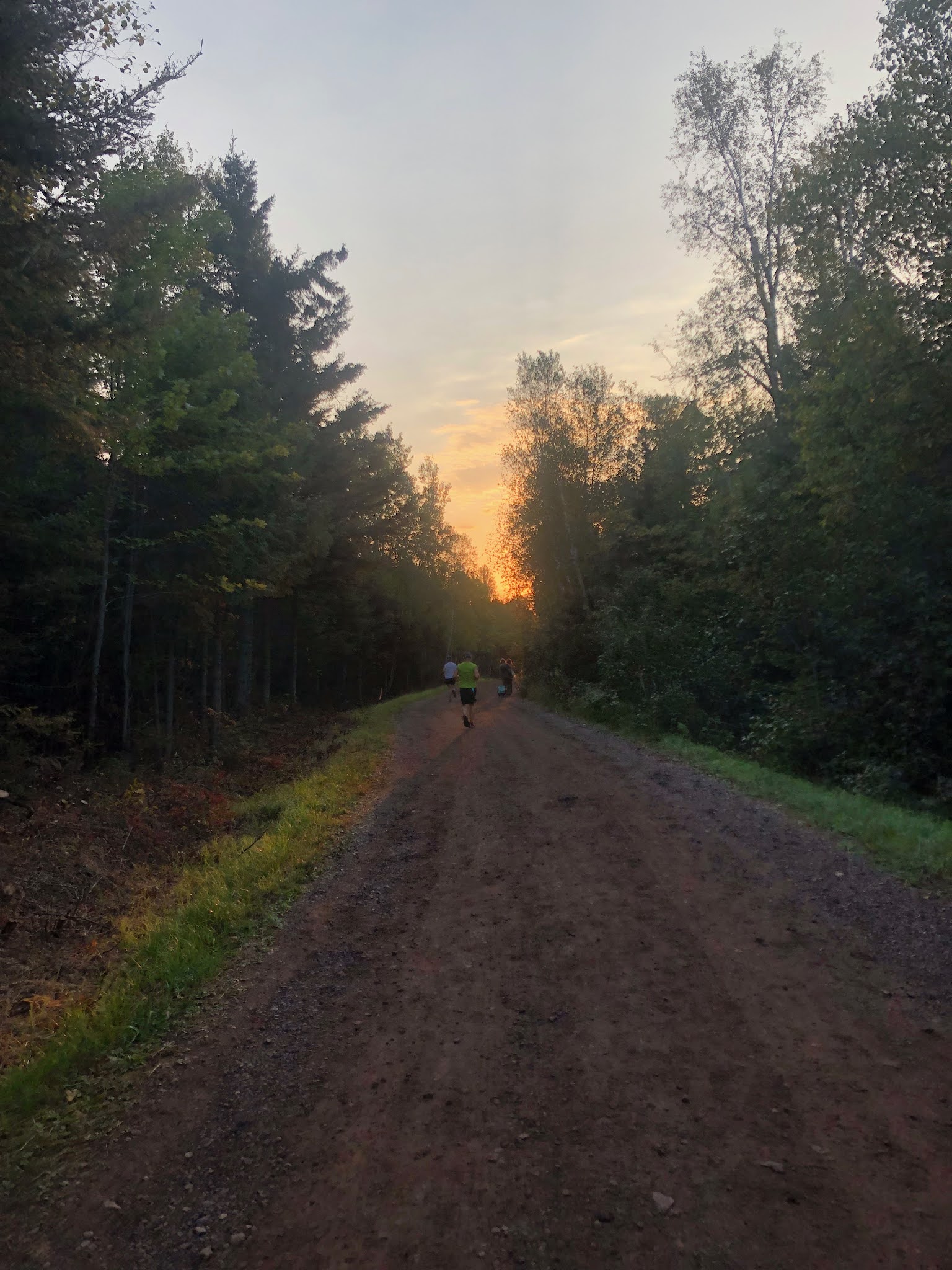
This allowed the other two runners to get ahead of me just a bit, a fact that gave me some relief as it allowed me to sit back and run my own race at my own pace. It also gave me a chance to take a picture of the sunrise as we made our way into the second aid station. Allowing myself to stop and take pictures of particularly beautiful views was part of my strategy to keep to my mantra “relax and enjoy.” Stopping to give Bill a fist bump was another part. 


The last part of the route to the aid station was along a gravel road, heading nearly due east. This gave me the chance to take a picture of the sunrise. 


(Section time: 45:51, Time in Aid: 27s)


Section Three: Crosby-Manitou to Sugarloaf - Running Ahead of Schedule


I realized at this aid station that I was already running far ahead of my predicted splits. In fact, if I continued running so quickly, I risked missing my crew entirely at the next aid station. They planned to get there around 9AM for my expected arrival no earlier than 9:30, and I was on track to get there at 9 on the dot.   Regardless, I took very little time in aid, grabbing my drop bag and filling an extra water bottle for what I knew would be the longest stretch of trail for the day. The extra water bottle, unfortunately, slipped straight through the front left pocket on my vest (a defect I hadn’t noticed until now), and I was left carrying it in my hand until I drained it. 


We were now in Crosby-Manitou State Park, familiar territory to me for the first time of the day, and for the only time until we reached Carlton Peak. My dad and I had gone backpacking here some 20+ years ago, and the trails were just as steep, rocky, and root-covered as I remembered. In what would be a theme for the day, I found myself thinking two thoughts over and over: first, the trail was often steep and technical; second, the climbs on this trail were universally short. I cut my teeth trail racing in Colorado, and even the longest climbs on the Superior course (the climbs up Carlton Peak and Moose Mountain) are short compared to even the shorter climbs in Colorado races. 


In Crosby-Manitou, another (new) runner caught up to me. As usual, I could hear him before I saw him, particularly an exclamation of “isn’t this bullshit” on a particularly steep climb (my unsaid thought in response was “did you sign up for the same race I did?”), and noticed that he was not at all hesitant to drop into a power hike in the steep and/or technical sections, but quickly reverted to a run in whenever it got smooth and/or level again. I opted to emulate him, and while he overtook me for a few minutes, I quickly re-passed him and didn’t see him again all day. 


This section also saw my mental low point of the race. In part, it was a response to talking with the other runner, checking in on how we were feeling. He said he was awful except for his legs, which felt great. I, in turn, was feeling great except for my legs, which, while not awful, were not feeling as good as I had hoped less than 20 miles into the race. I also noticed some hot spots flaring up along the insteps of each foot. I had glued my insoles to the bottoms of my shoes, having had too much experience with Altra insoles riding up to the toes (including one memorable instance when I had to remove them and run 20 miles without any insoles at all), but glueing them to the sole of the shoe had left just a tiny gap between the insole and the shoe body, and this was now rubbing against my foot uncomfortably. My only question was whether to change socks and possibly shoes at the next aid station or at the following station (the halfway point of the race).


Looking at my watch, I realized again it might be a moot point: I was still far, far ahead of my predicted pace. I was on pace to come into Sugarloaf between 9:00 and 9:05. Sure enough, when I ran into the aid station just after 9AM, my crew (my wife and my parents) had not arrived yet. I grabbed my drop bag, filled my bottles (one nuun, one water), and wandered around trying to think how to signal to my crew that I’d already been there. I had settled on describing my father (“6’4”, white hair and beard, looks like me”) to a helpful volunteer (as opposed to the other kind, of which there are none in this race), when I spotted my wife and mother walking down the road towards me. I flagged them down, let them know that I would probably want to change socks and/or shoes at the next aid, and took off down the trail again. 


(Section time: 1:50:36, Time in Aid: 4:40)


Section Four: Sugarloaf to Cramer - Settling In


Off again, I again noticed something that I had found happening the previous section: while I was starting to feel the fact that we’d already been running for more than four hours, and my right quad was a little sore, I wasn’t cramping at all, and running felt better than walking did. This would remain true throughout the race, at least until they both felt equally difficult at the end of the race. 


So I ran most of the time, and every ten minutes took a quick walk break while I took a drink (at the 10, 30, and 50 minutes after the race hour) or took in some food (at 20, 40 and the hour). This drinking/nutrition pattern has worked well for me for several years now, as long as I adjust how much water I take in depending on the temperature. 


Using this pattern, I soon came up behind another runner in blue, whom I hadn’t seen yet. Spencer had been running well but had cramping issues. It was his first fifty, having run the Moose Mountain Marathon when it was last held in 2019, but he seemed to be doing pretty well. I ran with him for a few minutes, glad of the chance to talk, before running along ahead again. 


It wasn’t long before I came up behind another runner: the same one who had missed the logging road turnoff at the beginning of the race. He said he was cramping badly and suffering, so I offered a salt tab (which he refused). Seconds after I passed him, he fell over a root, and I ran back to check on him, leaving him with a salt tab after he assured me he could keep moving. 


This whole section I was moving well, so inevitably I took an unexpected and abrupt fall on the smoothest, easiest section of trail. Parkour training kicked in, and I turned it into a perfect shoulder roll, and ended up springing back up on my feet none the worse for wear, with all my food and bottles accounted for. Naturally, I only fall like this when I am completely alone. When somebody else is watching, I inevitably fall flat on my face. 


Soon, it seemed, I was cruising down a smooth trail into the Cramer Aid station and my first real crew stop of the day. 


(Section time: 1:05:14, Time in Aid: 5:39)


Section Five: Cramer to Temperance - Wait, it’s Fall?

This aid station was the longest stop of the day. I opted to change into thicker socks, in an effort to avoid blisters, but keep the same shoes, as they were feeling good other than that minor hot spot on each instep. I had no blisters yet, and figured if they started in the next 12 miles, I could take care of them at the next crew stop (there is no crew access at Temperance for 50 milers). So after again grabbing a third water bottle and my trekking poles (for the climb up Carlton), and saying a quick “thank you” to my crew and the aid station volunteers,I took off down the trail. 


The new socks made an immediate difference, and with feet feeling good again, I cruised along for a few miles before hitting the Cross River trail section. While a beautiful section of trail along the river, this was also a series of short, highly technical ups and downs l, and it slowed me down. I was now 6 hours and 50kinto the race, but to my surprise I still felt about as good as I had ten or fifteen miles earlier. 


The hundred milers were appearing ahead of me regularly now, and I developed a system for passing. I would run up behind and match their pace, letting them know I was there and that, whenever the trail allowed it, I would pass them. Most still insisted on stepping aside for me, but if the runner didn’t want to stop and step off the trail, this let them keep moving forward (“relentless forward progress”). With quick “thanks” and “you’re awesome,” I would move on down (or up) the trail. I saw several faces I recognized, some of whom recognized me back, and I was again reminded just how small and tight-knit the trail running community in this state is. 


In my opinion, this is one of the most beautiful sections of the course. After climbing out of the Cross River gorge, you run for a mile along a ridgeline before dropping into Temperance. This is one of the few areas of the course where you regularly get clear views out over Lake Superior, and the fall colors out (already) were simply stunning. I did stop and take a landscape and a selfie, because why not?


The descent into Tettegouche was a blast. While my right quad was definitely sore by this point, I was able to run smoothly down into the aid station, passing several more 100 milers and their pacers as I did so. And at the same time, I approached familiar yet unfamiliar territory. Familiar, because I was approaching the spring 50k course, unfamiliar, because at the aid station I equaled the farthest distance I had ever run, with 18 miles and the three biggest climbs of the course in front of me. 


But at least I knew what I was in for.


(Section time: 1:26:58, Time in Aid: 3:04)


Section Six: Temperance to Sawbill - Up and Over


With no crew access at the Temperance station, I moved through a little more quickly. I was anxious to get out and on my way up Carlton, but first I had to run along the heavily-trafficked trail along the Temperance River. 


After running on my own for so much of the day, 6 ½ hours at this point, it was strange to suddenly be among people not part of the race, hiking, chatting, and playing in the (low) river. By and large, as people are, they were pleasant and polite, stepping out of the way and saying “nice job.” Some asked questions (“How far have you gone?” being a common one. “Is there a race?” being another). Most just offered an encouraging word and stepped to the side of the trail. As I said, it was a strange slice of normal life, equal parts jarring and comforting. 


Then the course turned northeast and up again, towards Carlton Peak. 


I had been secretly dreading this section. I had heard horror stories from other, more experienced Superior runners about how long and difficult the climb was. I’d even grabbed my trekking poles just for this section. So I was somewhat surprised by how mellow the first mile and a half of the climb really was: mostly runnable even in the second half of a 50 miler. 


When the steep section finally hit, I was glad of the trekking poles. While I would have been fine without them, the extra two points of contact made me more sure-footed and I’m sure made me faster overall. But I was shocked by how short the climb seemed, and how quickly it was over. The two steepest sections of the climb lasted maybe a half mile total, gaining about 500 feet over that distance. Steep, yes, but also short. 


My perceptions may be skewed by cutting my trail running teeth in Colorado. 


Nonetheless, Carlton passed quickly and without incident, up or down (though my right quad was really quite sore by this point), and I cruised into the aid station to see my crew again. 


(Section time: 1:12:39, Time in Aid: 4:57)


Section Seven: Sawbill to Oberg - Familiar Territory


This aid station came with an issue: until this point, I had been eating well. Every twenty minutes, I’d shovel down either half a Honey Stinger waffle or half a bag of Honey Stinger Chews (thank you to Honey Stinger: as a member of the hive I get a discount on these). It was working well, and keeping my energy levels consistent, but I was starting to get tired of the sweetness. I was willing to try other options. 


At the aid, I tried the new Honey Stinger hydration mix, but that nearly made me throw up. Beef jerky (another fallback) wasn’t going to do it. I grabbed a few options from the aid station, and decided that if I was unable to eat anything else, I could reasonably expect at least one of them to go down. In the meantime, I opted, unappetizing as it was, to continue with what had worked so far. While it wasn’t appetizing any more, it was at least keeping me moving well. 


I remembered this section being relatively flat during the 50k, and was mostly correct. There were three smaller climbs, again mostly runnable, and I generally stuck to my “run 9, walk 1 while eating and/or drinking” routine.This section provided a new bonus: I regularly passed the back of the marathon pack, each of whom gave me a mental boost and verbal encouragement. One of the marathoners mentioned that I was in sixth place, the first time I’d known where I was in the pack all day. I was surprised to be so far up in the pack, but I knew I had been running well all day, and would be in the top ten or so most years. At this point, I hadn’t seen another 50 miler in nearly 20 miles, so also wasn’t expecting to change positions again in the race . . . 


Illustrating just how well this run was going: I ran this section two minutes faster than I ran the same section in the Superior 50k in 2014, when I placed 11th. 


(Section time: 1:09:18, Time in Aid: 3:21)


Section Eight: Oberg to Finish - Bringing it Home 


This aid station was the least smooth for me and my crew. I had intended to take my third water bottle on this section, but somewhere between the last station and this one, it was misplaced. Chalk it up to experience: I did not make it clear that I would want that bottle again, nor did I bring an extra water bottle for such an occasion. I’ll know for next time. 


Fortunately, it was the last aid station, with seven miles to go, and I knew that even if I ran out of water I would finish the race. 


And now I had an added motivation: I could see the fifth place runner walking out of the aid station as I was grabbing the last of my gear for this section. The finish was tangible, if three climbs away, but the runner ahead of me was literally within sight, and didn’t look to be moving well.  


This marked the first time in the race I allowed myself to do two things. The first was to use some honest race tactics. Knowing I was just behind the fifth place runner, I took time to prepare my pass. I hit a walk break, had a drink of water, then surged past him between Oberg and Moose Mountain. There’s nothing quite so demoralizing as a competitor breezing by you in the last stage of a race, even if you know they are just putting on a good show for you. 


Second, I allowed myself to think about the finish. All day, the only distance in my mind, and on my watch, was the distance to the next aid station. But barring sudden injury, there was no chance I was going to fail at this point. With that in mind, I put in a good pace up Moose Mountain, trekking poles helping me push up and over the top, passing marathoners the whole way.


Down Moose, and the quads were really feeling it now, but I knew there was actually relatively little climbing and descending to go before the finish. Mystery Mountain, as I was now viscerally reminded, was a relatively shallow slope, and while I was having a harder time willing myself to run again whenever I took a walk break (now just washing waffles down with a squirt of water), running itself still felt pretty decent. 


At the “top” of Mystery, Amanda “Smashem” Basham made an appearance, cheering us on, which gave the final boost I needed to really push well on the long into the finish. The last mile, as I had hoped, was the fastest of the day in 8:36, and my form in the finish chute looked pretty dang good for mile 53, if I do say so myself. 


Mile 53


Thank you to my crew for shepherding me through the aid stations and taking care of me afterwards. Thanks to all the volunteers (1 volunteer for every 3 runners) who made the race run smoothly. Thanks to Honey Stinger for welcoming me to the Hive. And most of all, thanks to John and Cheri for putting on the race despite all the difficulties involved this year.


Sunday, March 3, 2019

Thoughts on the Run #3: Fountain Cave

On my long run the other day, I ran past a historical marker. You know, the ones that are heralded by green or brown signs across the small highways of the United States. The ones most people pass by without a second thought.

In fact, I have run by this plaque several times in the past without stopping. This time, though, I caught the title of the plaque out of the corner of my eye: "Fountain Cave." I find caves fascinating, so I turned off the bike path to give it a look.

Apparently, just downstream from the marker, there used to be a cave with a stream pouring out of it. In its time, it was one of the more famous landmarks along that stretch of the MIssissippi. Back in the early 1800s, it was popular with explorers, several of whom wrote about it in their journals. Travelers and tourists used to stop there on their travels up and down the River. The sculpted sandstone cliffs were said to be beautiful.

It was also the site of the first permanent (meaning, I assume, white, European) structure in St Paul. In the 1830s, a cast-off from Fort Snelling, just upriver, built -- what else -- a saloon there. Later on, there was even a small refugee settlement on site.

Why, then, I wondered, had I never seen or heard of Fountain Cave? I have explored most of the length of both banks of the Mississippi over the past 5 years, and this is just the sort of feature that I would find fascinating. My favorite spot along the river is actually just upriver from the marker: a small slot canyon carved into the sandstone bluffs.

The cave doesn't exist any more: they filled it in to build the highway.

Go figure.

And that made me wonder: what does it say about us as a species that we have historically been so willing to destroy natural wonders for the sake of our own projects? Why were we so willing to flood Glenwoond Canyon for the sake of a reservoir? Why, on a smaller scale, did we fill in a natural wonder of Minnesota for the sake of a highway?

Why do we so often, to quote the song, pave paradise to put up a parking lot?

Tuesday, January 29, 2019

Thoughts on the Run, Post 2: Noise


Noise

I live in a fairy middle-sized city —a quarter million people or so — in a reasonably-sized metro area — 3-4 million people. I enjoy many aspects of city life: concerts, museums, shopping, dining; all the advantages you get by simply having a large population of people in a small area. 

There are parts of city life I really dislike, of course: all the straight lines, the constant presence of people, traffic, the lack of natural areas (even though we are relatively blessed in the Twin Cities). Mostly, though I dislike the noise. 

Noise has been difficult for me my entire life. When I was a child, they extended the freeway in my hometown to the point where it ends now: four blocks from my house. Suddenly, I had to deal with something I’d never really thought about before: traffic noise. I remember lying in bed in the summer, the window open — nobody in Duluth had AC, because Lake Superior served us better than any AC unit ever could —unable to fall asleep because of what seemed to me excessive traffic noise.

I would later learn that “excessive noise” is a relative term. 

I live in a city now. Not a very noisy city, in the grand scheme of things, but a city nonetheless. St Paul mostly shuts down after around 9PM on the weekdays, and 11PM on the weekends. Even so, there is constant traffic on the street outside our apartment. We are on an emergency route, so we get the addition of sirens Dopplering by our windows at odd times of the night. People talk and yell, sober or otherwise, and I am a light sleeper: I wake up every peep. 

On the other end of the spectrum, I went to college with people from NYC who had the opposite problem: they had difficulty sleeping in the quiet of the middle of nowhere, Maine. Many of them could not sleep without a TV or a noise generator in the background, because they had grown up with the constant sound of the City that Never Sleeps. 

Strange . . .

The ubiquity of noise was driven home to me viscerally the other day. I went for my normal run on a day when I was particularly stressed. When I feel stressed, my run tends to take me down to the Mississippi. Growing up in Duluth as I did, the mere presence of water has always calmed me down. 

There is one particular spot on the river where I stop whenever I pass it on my run. It’s a spot where barges dock in the summer, just downstream from an old grain elevator. We had just gone through a cold snap, and the river was partially frozen, blocks of ice floating downstream and crunching into each other. 

I sat and listened to the ice crunch for a while, but the sounds of the city — the traffic on the road behind me, the constant “beep beep beep” of construction vehicles backing up, the sirens of the occasional ambulance — kept intruding, and I couldn’t help but think that all this noise cannot be good for us. The constant stimulation, the incessant background hum. 

Even the Boundary Waters, far from the sounds of any city, lie underneath an international flight path. 

I don’t know of a solution, but as I sat there on the bank of the river that day, I longed for a moment of quiet. 


Sunday, January 13, 2019

Thoughts on the Run, Week 1

I have often said, to just about anyone who would listen, that “the best way to get to know a place is to run it.” 

I said this, believing it to be true. I espoused this. I tried to live this, and thought I was doing so. When I travel to a new city, I run it, sure in the knowledge that I will thereby be getting to know the place better than I would any other way. 

I have lived in my current neighborhood for more than four years, running locally the whole time. I felt confident saying that, based on my own maxim, I knew this neighborhood. 

But I have a confession to make: I was completely full of it. 

I know this now because I recently took up a challenge, posed by Rickey Gates, to run every single street in my neighborhood. 

After running more than 40 miles of streets and sidewalks, all within a mile and a half of my apartment, I can tell you that I did not know this neighborhood anywhere near as well as I had thought. Before this challenge, I had probably run less than 25% of these streets in four years. And these are the streets that, according to my own saying, I should know better than anybody. 

In the process of running every single street I found, among other things, a house that looks like it was transported straight from an English village, a row of mansions overlooking a homeless encampment, more Little Free Libraries than I could have imagined, and a Calvin and Hobbes mural painted on a garage door. I saw eagles, red-tailed hawks, and a fox. I found new allies, through, and dead-ends mere blocks from my front door. And I ran by more than a dozen churches.

So does my theory that the best way to get to know a place is to run it hold true? 

Maybe it does, but you have to run a place with intention. 

Sunday, January 6, 2019

Thoughts on the Run


I am a runner. 

People who know me well at all tend to be aware of this. Casual acquaintances tend to be aware of this. The elderly gentleman I run past several times a week no doubt is aware of this. When first learning about my “runner-ness,” there are a few questions that  inevitably arise. One of the most common is “what do you think about when you’re running?” 

To quote Quenton Cassidy, protagonist of the novel novel “Once a Runner,” I often answer “quantum physics.” As he said, it’s as good an answer as any, and for me, it has occasionally been the literal truth. In college, whenever I was stuck banging my head against a particularly difficult physics problem set or take-home exam, I would actually go for a run. More often than not, I would come home to find the solution floating in my mind. 

The truth is, on my easy runs, I think about anything and everything. During harder runs, as well as races, I think about the run or the race. I simply don’t have the mental space to think about anything else. But more than two thirds of my runs are easy, and my mind is free to wander. 

I have often thought that most of my more interesting ideas seem to occur when I’m running. More often than not, I don’t fully recall these meandering thoughts when I get back and return to my daily, non-running life. 

Lately, however, I have worked hard to write more regularly, in a more focused way. I confess I have had this intention many times: I have started and made significant headway on several books, novels and nonfiction. 

Never having been able to finish one of these longer works, I decided this time through to try to write shorter, more focused pieces. This is my attempt to do so. 

Each day, I run. 

Each day, my mind runs. 

And now, each day, when I return from my run, I write down a brief phrase or two that represents some of the thoughts that passed through my head during the day’s run. Later on that day, I use these phrases as a cue to jog my memory (apologies for the horrific pun) and expand on it, writing out long hand. If I deem it worthy, I will later edit it, type it out on the computer, edit it again, and post it here. 

Welcome to Thoughts on the Run. 

Saturday, November 24, 2018

A Tale of Two Ultras


A few weeks ago, coming off the high of a good long run and my first 50 mile week in years, I made what may have been an ill-advised choice: I signed up for a 50k and an 8-hour race a mere week apart. 

What can I say? It seemed like a good idea at the time. 

Or, as another runner so appropriately phrased it: “We’re ultrarunners. We don’t make good decisions.”

I will say in my defense that my goal race (Wild Duluth) had not worked out. I was going to be in another state that day. So I eyed the Hixon 50k, which was the following weekend, as a replacement race. I had just put in one of the better training blocks of my life, running both faster and farther than I had in years, and I didn’t want to waste my fitness. 

But then, I didn’t want to miss the Icebox 480, the unofficial end to the midwest ultra calendar, either. It’s always a fun day, and the 7 mile loop really allows you to see more people than you might think. Plus, I could drop out at any time. 

And a lot of my trail running friends were planning to be there. 

So yes, I had my justifications. The fact remained that I had never done anything remotely like running (potentially) two ultras within seven days of each other. Hixon being on a Sunday, I would only have five full days of rest between the two races. 

Naturally, a few days after signing up for these races, I tweaked my ankle during what would have been my last real pre-race tempo run. 

At first, that seemed like awful timing, but I quickly realized that it might have been the best possible time to have such a minor injury. I had already gotten through my hardest training block and my biggest mileage. I was just over two weeks out from my first race, and all my substantive training was already behind me. As long as I was smart and didn’t push my ankle too hard, too quickly, the forced taper that little niggling pain started might just be the best thing to happen to me. 

I took four days completely off running, foregoing my last longish run, and two other runs besides. I came back that fifth day, on a trip to Madison with my wife, with zero pain. Over the next week, my ankle twinged a couple times but never hurt in any serious way. I proceeded into the land of taper tantrums and over-thinking my gear. 

Hixon 50k

What can I say about this race? I controlled what I could control, and those aspects of the race went well. And what I couldn’t control, I managed. 

Things I could control:
I treated HIxon as a goal race, meaning primarily that I obsessed over this race to the detriment, or possibly the benefit, of the Icebox. As race day approached, and the weather forecast stayed the same (rainy and windy, with temperatures between 40 and 50 degrees), I went back and forth repeatedly on what to wear. 

I decided on a long sleeved New Balance cooling shirt, my capri tights, light gloves, my UMTR buff, and my normal socks and shoes. On top of that, at least for the first part of the race, I would wear my Altra StashJack, the one with the fully open back that’s designed to accommodate a vest. I would be wearing a waist belt, but I figured that the open back would allow better ventilation and keep me from overheating. 

I took the race out at a pretty decent clip, but not crazy fast. As usual, I found myself in the not-quite-lead group: two runners took off, and I stayed with the next group for a while. I wanted to run within myself for the first lap, and then see where I was during the second. “Composure, Confidence, Compete.” was my mantra for the day, courtesy of an iRunFar column. 

With that in mind, I ran much of the first lap with two other runners, chatting about work, about the course, and just about anything else that came to mind. They would drop me a bit on the hills, I would catch up on the flats and downhills. I saw no reason to push the hills on lap one. 

I went through the first of two 25k laps in 2:30 on the nose, feeling good and ready for lap two. 

Things I could not control:
Around mile three, I started to feel water running down my back that was more than the rain could account for. I reached for my bottles and, sure enough, the cap had come off of one of my two 10oz water bottles. I’d be stuck with half the water I had planned for during the remainder of the race. Not a huge deal, with the frequency of aid stations on the course, but it meant I ran out of water a couple times on the second lap. 

At about the same point in the race, I realized just how wet the trail was. So far, I was still in the top 10 runners, and the trail was in good shape. But there were more than 100 50k runners behind me, and another 350 25k runners would star an hour the 50k. The second loop, I knew, would be a muddy mess. 

And so it was. Within the first half mile of the second loop, I had almost fallen twice and I was running almost two minutes per mile slower than my first loop pace. I realized, though, that the rest of the field would be similarly affected, and sure enough, I came close to holding my position in lap two (passed one person, and was passed by two). 

Finally, around mile 22, my watch, now four years old and used almost every day, gave a resigned beep and asked me to “please recharge.” I would run the rest of the race with no GPS data, time-of-day only. 

Ah well, not that important in the grand scheme of things. I knew generally what the mileage was, and I knew we had started at 7:40AM, so no problems there. All I needed was to keep drinking every ten minutes, and eating my 80 calories every 20. 

I came through the second loop and finished the race in around 5:39 elapsed, 11th place over all. That’s good enough for my best place in a 50k. It’s half an hour off my best time, and not the time I had hoped for going into the day, but it was a solid effort and I felt satisfied. 

Between Races
I felt better than I expected after my 50k. I was tired, sure, but I did not experience the same beat-down, I-don’t-want-to-run feeling I often have after other, similarly long efforts. I credit my training for that difference. 

Nevertheless, I only ran once in the five days between Hixon and Icebox. I wanted to run at least once, since that would give me an indication of how I was recovering, but I didn’t want to let myself push the pace at all, so I ran with the Thirsty Thursdays at Theo group. Every Thursday, they run around five miles around Theo Wirth park in Minneapolis, taking about an hour to do so, and follow that up with a beer or two at Utepils. 

My legs felt tired, but not beat up, giving me more confidence going into Icebox. 

I had a few goals for Icebox. First and foremost: have fun. Icebox is the unofficial end of the trail racing season in the Twin Cities area, and it tends to be as much of a party in the woods as a race. I wanted to treat it as such. Second: I wanted to run an ultra-distance. With the approximately seven mile loop, that would be a minimum of four loops. However, and third, I didn’t want to push too hard. I wasn’t sure how my body would react, so I told myself to do whatever I could on the day, and not worry too much about time or distance. 

Icebox 480

Despite forecasts of light rain, Saturday dawned dry and chilly (35 degrees or so) as I drove the 30 minutes from my door to Whitetail Ridge in River Falls. In other words: it was perfect trail racing weather. I got to the start area about 30 minutes before the race was supposed to start, collected my trucker hat, and set up my drop box in the start/finish/lap area. 

I was taking this race much less seriously than the Hixon, so I decided to just go out with a group and see how I felt after each lap. 

The first lap I shared with what must have been the second group of guys (the lead group went out far faster than I wanted to), and the lead woman. I knew a couple people in the group already, so the lap was almost exactly what I hoped for: an easy-ish run in a beautiful area with some friends. Even feeling relatively easy, though, we went through the first ~6.8 mile lap in under an hour. I had thought ~1:05 per lap would be an easy, sustainable pace for me. But my legs wanted to go for hour pace, so that’s what I ran. 

I say the pace was easy, but that’s not quite accurate. At no point during the day did my legs feel good. From the first few steps, I could tell viscerally that I had raced a difficult 50k the week before and that I was not fully recovered. Despite that, I found that I was still able to travel at a good clip. I had less power on the uphills than I often did, but the only hill I walked during the whole race was the steepest hill on the course, at the one mile mark. I decided before I started the run that I would always walk the steeper part of that hill, and I stuck to my plan.

I noticed something else in laps one through three as well: I am not sure why, but I was much stronger relative to other runners in the second half of the lap than the first. I would consistently catch people about 40-50 minutes into my hour-long laps (and laps 1-3 were all just under an hour, not counting my stops at the beginning/end to use the restroom, top off my water bottle, and grab some more calories), and would remain ahead of them until the start/finish area. 

Laps two and three were much like the first. My legs never felt good, exactly, but I could keep a good pace regardless. While the pack I ran with the first loop quickly disintegrated on the second, I started to catch and lap slower runners on these loops, each time getting a little mental boost from interacting with them. I continued with my very successful fueling strategy (drink at least once every 10 minutes, eat 80 calories every 20), and had comfortably settled into the day. 

I briefly considered calling it a day at three laps, but opted to head out on lap four any way, knowing that I had enough in me to finish that, at least. Lap four was a different beast. I was really feeling the fatigue now, both from the day but more, I think, from the previous Sunday. I took one spill in the Hixon that just mildly torqued my left knee, and that started to make itself known late in lap three. I slowed down considerably on lap four, opting to walk while I ate instead of running. 

Mentally, I was still there and thinking that I might do lap five and see whether I might be up for more after that. Again, though, I had already decided that I would pull the plug when the day ceased to be fun. This was not a goal race for me, just a chance to see what I could do. Simply put: I was ready to have fun, but not to enter the pain cave.

So when I pulled into the start/finish area again after 1:15, almost 15 minutes slower than my prior laps, I checked in with myself. My form had started slipping (inevitably). My knee was hurting (see above form note). I had run around 28 miles, a week after racing 31. 

I gave myself some time to change my mind, and even called my parents about my brother’s birthday present. After that assessment, though, I decided that this was not the day to try and break my own distance record, but a day to celebrate just how well my training had gone this cycle, and look ahead to what I am sure will be a remarkable 2019. 

Self Assessment:

In all, I’d raced nearly 60 miles over two weekends, separated by just five days. That’s something I would not have even considered a couple years ago. More importantly, I finished the season without the malaise that sometimes settles in: there was no voice in my head saying I just didn’t want to run any more. 

Two weeks out from Icebox, I ran the UMTR Fall Fatass Frolic yesterday: 9.3 miles in 1:06 and change. I also bought a skate-ski setup, something I have meant to do for years. And this week, I think I might just start my own local version of Rickey Gates’s “every single street” challenge. 

Also, somebody did the Border Route in 25 hours, and I think I want to lower that mark. 

Sunday, November 18, 2018

Barriers


Barriers are funny things, particularly when they are mental barriers. 

For the entire time I’ve been running, or at least, the time I’ve been keeping track of mileage, the 50 mile week has seemed like both a major barrier and a major breakthrough point. There is no reason that 50 miles should hold such esteem in my mind. 49 miles, seven miles each day, might make more sense from an aesthetic perspective, but from a training perspective there is no real reason that 50 miles is any different than 45 or 55. 

Nevertheless, it has always been firm in my mind as an almost mythic barrier. I have flirted with 50 mile weeks fairly regularly. I often surpass 40 in my training. Somewhat less often, I start to hit around 45 miles per week, usually in the lead up to an ultra. Rarely, though, have I hit 50 miles in the span of a week (I define a week as Monday-Sunday). 

The very few times I’ve reached that point in my training, though, there was no real momentous occasion to it. The 50 mile mark almost seemed to sneak up on me and pass me by. 

That is exactly what happened to me this past weekend. I had run 46 miles the week before, a total that was somewhat unexpected to begin with. I actually ran a good six miles shorter than I expected on my normal Saturday long run, after waking up and feeling tired and uninspired by trail running. To my surprise, after a leisurely 12 on Saturday, I got up on Sunday and ran a fast eight to close out the week on a high note.

This past week,I got a good start. After resting Monday, a day I take off religiously, I hit eight miles on Tuesday, complete with my fastest non-race mile in three or four years sandwiched in the middle of a steady-state run. Wednesday was easy and short. Thursday, I ran twice: six miles fast in the morning, and five and a half in the evening at a slow pace. (Thursday evenings I have started running trails with a couple different groups, which allows me both to socialize and to get some easy trail miles in when I normally would not). Friday was again easy and short. 

I went into the weekend with 27.5 miles on my legs, and no thought of hitting 50 for the week. 

Saturday, though my legs were still carrying a good bit of fatigue from the week, I ran a solid 16 miles out at Afton State Park. I stopped often, taking pictures of any mushrooms or fungi I saw, and chatting with the other runners sharing the trail on what was, after all, a gorgeous morning for a run. I even managed to pick up the pace for the last three miles back to the car. That was 43.5 for the week. 

Sunday, I still had no intention of hitting 50 for the week. 

But Sunday was Twin Cities Marathon day, and I ran around spectating. Soon enough, my watch said four for the morning, and my legs and brain said “why not?”

So I kept running until I hit just about seven miles. And the mythic (in my mind) barrier was broken. 

In the grand scheme of things, obviously. 50 is just another number. But the mere act of running that much in a week has done wonders for my own confidence in my training. More than that, the relative ease with which it happened (there was no special scheduling, no particular addition of miles or runs), and the two relatively low-mileage days in the middle make me think I could do it again. 

And maybe do even more.